
Chinese Poker has surged in popularity as a fast-paced, strategy-rich card game, offering a unique twist on traditional poker formats. Whether you’re a seasoned player or new to the felt, understanding the nuances between traditional Chinese Poker and its exciting variant, Open Face Chinese Poker (OFC), is key to mastering the game. This guide will break down the rules, scoring, and strategies for both versions to help you decide which one is right for you.
The Basics of Traditional Chinese Poker
In traditional Chinese Poker, up to four players receive a 13-card hand from a standard 52-card deck. The objective is to arrange these 13 cards into three separate poker hands:
- The Back Hand: A five-card hand, which must be the strongest of the three.
- The Middle Hand: A five-card hand, which must be weaker than the back hand but stronger than the front hand.
- The Front Hand: A three-card hand, which is the weakest of the three. Valid front hands are three-of-a-kind, a pair, or simply a high card.
This fundamental rule—back hand strongest, middle hand in the middle, and front hand weakest—is the cornerstone of the game. Failing to set your hands in this order results in a “foul” or “mis-set,” which means you automatically lose against all non-fouling opponents.
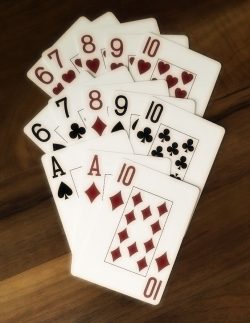
Scoring in Traditional Chinese Poker
Once all players have set their hands, they compare each of their three hands (front vs. front, middle vs. middle, back vs. back) against each opponent. For each hand you win, you get one point (or “unit”). If you win all three hands against an opponent, this is called a “scoop,” and you typically earn a bonus, often doubling the points to 6 instead of 3. The most common scoring systems are the “2-4” method (1 point per hand, 1 bonus point for a scoop) and the “1-6” method (1 point per hand, 3 bonus points for a scoop).
An Introduction to Open Face Chinese Poker (OFC)
Open Face Chinese Poker introduces a thrilling element of incomplete information and dynamic decision-making. Instead of receiving all 13 cards at once, players receive an initial five cards to place in any of the three hand positions. After the initial five, players receive one card at a time until all 13 spots are filled. Crucially, once a card is placed, it cannot be moved.
This sequential card placement makes OFC a game of foresight and risk management. You must build your hands without knowing what cards are coming next, all while adhering to the back-middle-front strength hierarchy. Fouling a hand in OFC is a significant risk and carries a heavy penalty.

Scoring and Royalties in OFC
Scoring in OFC is similar to the traditional game, with points awarded for winning individual hands. However, OFC adds an exciting layer with “royalties”—bonus points awarded for making particularly strong hands, regardless of whether you win the head-to-head comparison. Royalties are a key part of OFC strategy, as they can quickly accumulate and lead to massive point swings.
Common royalties include:
- Back Hand: Bonuses for Straights, Flushes, Full Houses, Quads, and Straight Flushes.
- Middle Hand: Larger bonuses for the same hands, with Three-of-a-Kind often being the minimum to score.
- Front Hand: Significant bonuses for pairs (starting from sixes, known as “Fantasyland”) and Three-of-a-Kind.
Key Strategy Differences: Traditional vs. Open Face
While both games share a common foundation, the strategies diverge significantly.
Traditional Chinese Poker Strategy
With all 13 cards known from the start, the strategy revolves around finding the optimal arrangement to maximize your chances of winning at least two hands against your opponents. The primary goal is to avoid getting scooped. Sometimes, this means sacrificing a very strong hand in one position (like a full house in the back) to strengthen your other hands and secure a 2-1 victory.
Open Face Chinese Poker Strategy
OFC strategy is more about managing risk and maximizing potential. Key considerations include:
- Foul Avoidance: Your top priority is to set a valid hand. Placing a high card like an Ace or King in the front hand early can be risky if you don’t draw cards to make a stronger middle and back hand.
- Royalty Hunting: Actively playing for royalties is crucial. A well-placed connector could lead to a straight in the middle, earning valuable bonus points even if you lose the hand itself.
- Fantasyland: Reaching “Fantasyland” (typically by making a pair of Queens or better in the front hand) is a game-changing goal. In Fantasyland, you receive all 13 cards at once on the next hand, giving you a massive advantage.

Which Version Should You Play?
Play Traditional Chinese Poker if: You prefer a more straightforward, strategic game with complete information. It’s an excellent game for analytical players who enjoy solving the puzzle of arranging the optimal 13-card hand.
Play Open Face Chinese Poker if: You enjoy dynamic, high-variance games with an element of luck and risk. OFC is perfect for players who thrive on making decisions under pressure and love the thrill of chasing big bonuses and game-changing royalties.
Ultimately, both versions of Chinese Poker offer a refreshing and deeply engaging experience. Start with the traditional rules to grasp the fundamentals, then dive into the exciting world of Open Face to test your nerve and adaptability. Good luck at the tables!
Editorial Review: This guide has been reviewed by the editorial team for clarity, practical value, mobile usability, payment safety, and safer decision-making.